


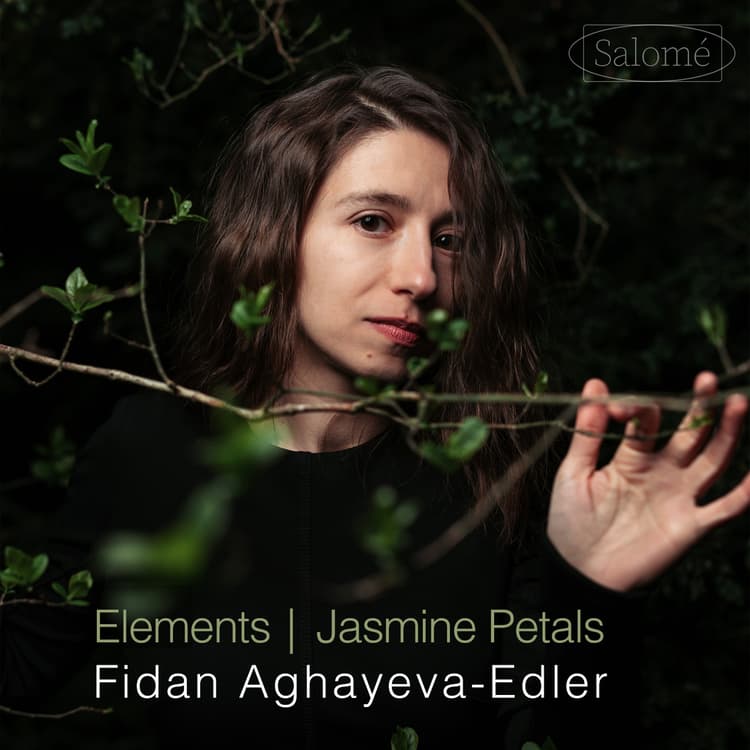
Album I - ELEMENTS
- Marti Epstein The Piano at the Palace Beautiful (2019)
- Jobina Tinnemans Seven Sisters (2020-2021)
- Carolyn Chen Tearing (b) (2018)
Album II - JASMINE PETALS
- Liza Lim The Four Seasons: Winter (2009)
- Hannah Kendall Processional (2018)
- Rahilia Hasanova Jasmine Petals (1998)
- Aleksandra Vrebalov Indigo Codes (2019)
- Aleksandra Vrebalov Danube Etude (2021)
In the years after the Covid pandemic Fidan Aghayeva-Edler’s Piano Marathons have become a feature of European concert life. For hour after hour, sometimes day and night, she plays a sequence of pieces, all of them composed by women, all of them played with extraordinary insight, skill and commitment. This double album presents eight moments from these epic musical adventures
The first album, ‘Elements’, begins with The Piano at the Palace Beautiful (2019), Marti Epstein’s wonderfully imaginative response to an episode in Louise M. Alcott’s novel Little Women. Beth, one of the March sisters whose stories are at the centre of the novel, is allowed to play the piano in a neighbour’s house, a house that the fanciful March girls have cast as the ‘Palace Beautiful’. The title is a reference to John Bunyan’s 17th century Christian fable, A Pilgrim’s Progress, and so Marti Epstein’s piece begins with a Methodist hymn. As the music progresses it conjures the spirit of Beth March, in love, as Epstein says, with ‘the tactile sensation of touching the keys and the resulting sound that pours out’.
Sorority also informs Jobina Tinnemans’ Seven Sisters (2020-21), each movement a portrait of one of the daughters of Pleione and Atlas. Greek mythology tells us very little about these women, only that Zeus found them so desirable that he turned them into the stars that we now know as the Pleiades constellation. Jobina Tinnemans’ music gives each sister an individual identity, to speak, to sing, perhaps even to dance. The final ‘Element’ of this first album is, like The Piano at the Palace Beautiful, music that grows out of other music. Carolyn Chen’s Tearing (b) (2018) takes its title, and fragments of its musical material, from the first of Scriabin’s Preludes, Op.74. Scriabin’s Prelude has the performance direction ‘Douloureux déchirant’ and Chen’s music is an exploration of this sense of a heartbreaking sadness.
The second album, ‘Jasmine Petals’, opens with music inspired by visual imagery. Liza Lim’s ‘Winter’, one of the Four Seasons that she wrote in 2009 after seeing Cy Twombly’s Quattro Stagioni in the Museum of Modern Art in New York. Lim reads Twombly’s work as ‘seasons of an inner life’, as ‘climates of feeling’, explaining that her music is a response to the paintings’ ‘ecstatic saturated colour’ and ‘calligraphic dynamism’.
Hannah Kendall’s Processional (2018) is also a response to a painting. Normal Lewis’s Processional is an epic image, nearly five metres high and more than nine metres long, across which abstracted black and white figures process. Lewis was inspired by the US Civil Rights march from Selma, Alabama to the state capital, Montgomery in 1965, and his painting represents that struggle for justice. In a remarkable act of musical compression, Hannah Kendall distils the painting’s sense of communal strength and resistance into just a few minutes of piano music,
Rahilia Hasanova’s Jasmine Petals (1998) is a series of seven miniatures, each inspired by the composer’s thoughts about ‘the fragility of our lives’. This is music haunted by the passage of time, each miniature exploring its particular world of piano sonority then vanishing into silence, like jasmine petals drying up and dropping from the flower. Where the seven-movement cycle of Jobina Tinnemans’ Seven Sisters depicts mythological figures, eternally preserved in the night sky, the lifespan of each of Rahilia Hasanova’s Jasmine Petals is all too brief.
The album ends with two pieces by Aleksandra Vrebalov. The first was written in an old town on the Turkish-Syrian border where, in February 2019, she was giving music lessons to displaced children from Syria and Iraq. The composer says of Indigo Codes that ‘the simplicity of sound’ and ‘the space created through silences and repetitions’ were her ‘daily grounding ritual’, an antidote ‘to the intensity of feelings and the density of despair’ that she experienced.
The album closes with Aleksandra Vrebalov’s Danube Etude (2021). If Carolyn Chen’s Tearing is a deconstruction of the concept of the ‘Prelude’, then this music is a radical reconception of the ‘Étude’. All that is left of the strict discipline of the ‘study’ is a rising figure, the first five notes of a C minor scale, that is repeated throughout almost the whole piece. Fragments of melody fly above and around this ostinato, sometimes growing, sometimes dissolving and, just before the piece finishes, briefly overwhelming it.
Christopher Fox, 12 December 2025
Recording Album I: Clynfyw mansion Wales, 16 September 2024, Recording and Mastering Jobina Tinnemans
Recording Album II: Texas Woman's University, 22 February 2025, Recording Ermir Bejo, Mastering Jobina Tinnemans
Photography: Jeremy Knowles
Financial support: Käthe-Dorsch - und Agnes-Straub – Stiftung
